How Are Medical Schools Abroad Different from the UK?

If you’ve been Googling “where can I study medicine in the UK?”, you’ve probably noticed 2 things popping up everywhere: there’s a serious shortage of doctors, and more students than ever are choosing to study medicine abroad, especially in Europe. That naturally raises the question: what actually makes studying medicine abroad different, or even better, than going to a UK medical school?
In this blog, we’ll break down those differences, explore the real benefits of studying medicine abroad, and help you figure out where you should study medicine.
Key takeaways in this blog include:
- UK medical schools are extremely competitive and expensive, while studying abroad offers a more realistic and affordable path
- Many medical schools abroad teach fully in English and offer degrees that are internationally recognised
- Studying abroad gets you early clinical exposure and hands-on experience
Table of Contents
- 1 What Are the Entry Requirements to Study Medicine in the UK?
- 2 How Much Does It Cost to Study Medicine in the UK?
- 3 Should I Study Medicine in the UK?
- 4 Why Study Medicine Abroad?
- 5 What’s the Difference Between Medical Schools in the UK and Abroad?
- 6 What Are the Popular Destinations for Studying Medicine Abroad in English?
- 7 What Comes After Studying Abroad?
- 8 Why We Care: How Medlink Students Can Help You
- 9 Q&A
What Are the Entry Requirements to Study Medicine in the UK?
Most UK medical schools expect:
- A*AA in A-levels or more
- High UCAT scores (at least in the 2700-2900 range)
- A strong personal statement
- Multiple interview rounds
How Much Does It Cost to Study Medicine in the UK?
UK medical schools aren’t cheap. If you’re a home student, you’re looking at £9,250 a year in tuition. If you’re an international student, it can be 4 to 6 times higher.
Then there’s London. Rent alone is a punch in the face. Add food, transport, and some leisure, and you’re easily at £1,300-£1,400.
Should I Study Medicine in the UK?
There is no doubt that teaching quality in some UK medical schools is high, and your degree from a UK medical school will be globally respected. You’ll quickly also learn that it’s expensive and highly competitive, with very limited spots for both national and international students. In fact, in 2025, there was a 10% increase in applicants (25,770 total), and less than 1 in 3 applicants scored a seat to study medicine in the UK. That leaves about 17,500 suitably qualified applicants without a place, who either have to wait a year to try again or find alternatives.
Why Study Medicine Abroad?
More and more students are leaving their home countries to study medicine in Europe and the Caribbean at universities that offer programmes taught fully in English.
But instead of just assuming it’s a good idea, there are a few things you should genuinely stop and ask yourself:
1. Are These Medical Schools Internationally Recognised?
This is usually the 1st concern. And the answer is: yes, many of them are. Graduates from established universities in Europe and the Caribbean regularly go on to work in the UK, the US, Canada, and other countries. They do it through official routes like GMC registration or ECFMG certification, just like any other international graduate.
2. How Hard Is It to Get Into a Medical School Abroad?
Medical universities in Europe often:
- Have more flexible entry requirements than the UK
- Focus more on academic ability and motivation
- Offer alternative entry routes through entrance exams or foundation programmes
This gives strong students who were rejected by UK universities a real second chance, without lowering academic standards.
3. Is Studying Medicine Abroad Affordable?
Many medical schools in Europe, unlike those in the UK, offer:
- Tuition fees as low as €4,000 (£3466) per year
- Lower rent and living costs
- More affordable student lifestyles overall
4. What About Cultural Differences?
Many of the countries accepting international students have welcoming and inclusive societies that speak English and value multiculturalism. Studying abroad also helps you gain exposure to:
- Different healthcare systems
- Diverse patient populations
- New cultures and languages
- International peer networks
This global experience helps students become more adaptable, culturally aware, and confident. These are qualities that are necessary in modern healthcare.
What’s the Difference Between Medical Schools in the UK and Abroad?
| Aspect | Medical Schools in the UK | Medical Schools in Europe |
| Admission Process | Highly competitive. Requires top grades, UCAT/BMAT, a strong personal statement, interviews, and work experience. Rejection rates are very high. | Often more flexible. May rely on high school grades, a university entrance exam, or a single interview. Some offer foundation years for students who need extra preparation. |
| Course Structure | Typically, a 5-year (or 6, in case of a foundation year) structured curriculum with clinical exposure | 6 years. Many programmes offer early clinical exposure, smaller class sizes, and strong hospital integration. Some follow UK or US-aligned curricula. |
| Cost and Financial Support | £9250 per year, with limited scholarships. High living costs in cities like London. | As low as €4,000 per year. Lower living costs. |
| Student Life and Cultural Experience | Familiar to UK students, as well as intense academic pressure and limited international exposure. | An international environment with students from all over the world, where you will experience cultural variety, independence, travel, and a broader life experience. |
What Are the Popular Destinations for Studying Medicine Abroad in English?
Several countries are known for their English-language medical programmes, including:
Georgia

Georgia, and deservedly so, is 1 of the most popular destinations for students looking to study medicine abroad. If you choose 1 of its medical schools, you’ll essentially be:
1. Paying tuition fees as low as €4000 /year (£3,466) for an internationally recognised medical degree.
2. Getting excellent early clinical exposure, as well as access to whatever you need of modern medical equipment and labs.
As for universities, top choices to study medicine in Georgia include the European University of Tbilisi as well as the Petre Shotadze Tbilisi Medical Academy, both of which also offer a 4-year graduate entry path into medicine or dentistry.
Poland
Poland is ranked among the top 5 countries for studying medicine abroad, especially for students who care about recognition and long-term credibility, not just affordability.
The usual top choices for medical studies in Poland are:
1. Medical University of Bialystok
2. Andrzej Frycz Modrzewski Krakow University
5. Medical University of Warsaw
The training itself is solid. You get proper clinical rotations in well-equipped hospitals. Add to that the modern campuses and the international student mix, and Poland ends up feeling like a good middle ground: respected education, but without impossible entry requirements.
Croatia
Croatia, more specifically the University of Zagreb, is for you if you want a prestigious, high-end European med school name, but still want the path that’s doable.
It offers an English-taught programme, then you gradually shift from being taught theory by the best professors in the field into real practice through real-life simulators and early hospital attendance in the University Hospital Centre Zagreb.
Summer clerkships are mandatory in a hospital you choose. Let's also not forget about the high degree recognition: it’s internationally recognised, listed in the World Directory of Medical Schools, and will be your guaranteed ticket to the UK’s GMC registration.
Hungary

Hungary offers top-tier medical education, especially when it comes to clinical training and research. The University of Pécs is a good example. It’s been around since 1367, and today it attracts over 3,500 international students from more than 67 countries just in its medical faculty. That doesn’t happen by accident.
If you’re aiming for a pre-med route, McDaniel College Budapest is usually the go-to option. And if you’re more interested in veterinary medicine, then the University of Veterinary Medicine in Budapest is excellent.
What really stands out about Hungary, though, is the practical side of training. Students don’t just sit through lectures for years and hope for the best. There’s real hospital exposure, structured rotations, and a clear focus on clinical skills. And yeah, that actually matters when it comes to your CV and future licensing.
Latvia
Latvia, a northern Baltic country, offers nothing but excellence in medical education. To be more specific, the Riga Stradins University (RSU), located in the country’s capital, ranks among the top universities in the world.
The university offers a 6-year medical programme in English that’ll help you become recognised as a doctor not only in the UK but worldwide. And if you’re not coming from an English-speaking country, they’ll still get you on board through an English certificate.
You’ll be learning how to actually be a doctor in the state-of-the-art Pauls Stradiņš Clinical University Hospital, starting your clinical exposure early on.
Slovakia

Slovakia will always be on our lists, as it offers world-renowned medical and dental education, especially through the University of Pavol Jozef Safarik, which ranks among the top educational and scientific institutions not just in Slovakia but in Europe too.
You are also not limited to having other excellent options to explore, such as the Jessenius Faculty of Medicine at Comenius University with its state-of-the-art Martin University teaching hospital. Both offer GMC-accepted medical degrees as well as modern equipment to get you up to much higher than the international standard.
The real selling point here is not just that you’re going to Slovakia and coming out as a doctor, but the lifestyle you will have during your 6 years there. Low cost of living, safe cities, excellent public transport, and let's not forget that you're in the centre of Europe, so you'll literally be capable of having weekend trips to Vienna, Prague, and Budapest.
Antigua & Barbuda
This route appeals to students who want a more flexible, North American-style structure rather than the traditional European model. The University of Health Sciences (UHSA) offers an English-taught MD with a strong focus on preparing students for international licensing pathways.
1 standout feature here is flexibility. Through specific pathways, students can complete a 1-year pre-med, which shortens the overall timeline and reduces total cost.
The best part is that clinical rotations are not limited to the Caribbean. In fact, Students can complete placements at more than 30 affiliated universities, hospitals, and clinics in countries such as the US, the UK, and Canada. That matters because your clinical experience shapes how well prepared you are for licensing exams and real hospital work wherever you’d like to practice.
This destination suits students who want clearer links to international clinical systems and a pathway that feels less rigid than traditional medical programmes.
Tuition fees are €25,750 per year; however, Medlink Students offers scholarship opportunities that significantly reduce costs to just €7,300 per year. The scholarship is only available to students applying to UHSA through Medlink Students. Book a free consultation today, and we’ll get you started on the journey to having the highest international standards for medical studies.
Barbados
Barbados is where you’ll find the American University of Barbados. It doesn’t follow the classic European medical school style. Instead, it’s closer to how medicine is taught in the US. The programmes take either 4 or 5 and a half years, depending on the course, they’re fully in English, and they’re built for students who want options outside just 1 country.
AUB follows a system where students complete their foundational sciences first, then move into clinical rotations across affiliated hospitals in the Caribbean and the United States. That structure is especially relevant if your long-term goal includes the USMLE or working within US-aligned systems, while also being a perfect path if you’re planning to work in the UK.
Admissions are also more flexible than most European universities. There is no entrance exam, and applications are reviewed holistically.
AUB is accessible; however, there is only a limited number of spots for each cohort, so apply as early as possible to maximise your chances.
What Comes After Studying Abroad?
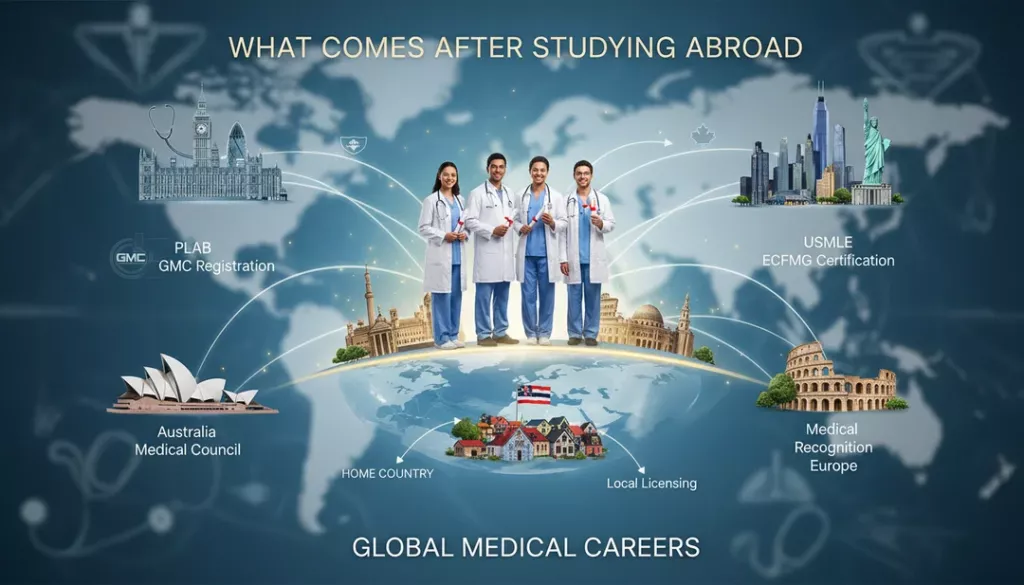
A medical degree earned abroad can open doors globally. Graduates may pursue careers in the UK (through licensing pathways such as PLAB and GMC registration), Europe, the USA (through USMLE and ECFMG certification), Canada, Australia, and their home country.
Why We Care: How Medlink Students Can Help You
Choosing the wrong medical school can have serious consequences. Some universities lack proper accreditation. Others offer weak clinical training. Some graduates later discover that their degree limits their career options.
Medlink supports students through every step of the process, including:
- Shortlisting reputable, recognised medical schools
- Helping with applications and documentation
- Entry exam preparation
- Interview coaching
- Guidance on visas and relocation
- Scholarship advice
Instead of guessing your way through 1 of the biggest decisions of your life, get free expert guidance tailored to your goals today.
Q&A
Should I study Medicine in the UK?
If you’re sitting on top grades as well as UCAT, and you can afford it, as well as afford losing a year in case you don't get a placement, it's definitely an option. Otherwise, it’s brutally competitive for no real advantage over good European options.
What Do You Need to Study Medicine in the UK?
A*AA grades at least, high UCAT grades, interviews, healthcare experience, and a strong personal statement.
How Long Does It Take to Study Medicine in the UK?
5 years typically, or 6 if you go through a foundation year.
How Much Does It Cost to Study Medicine in the UK?
UK students pay £9,250 per year. This is before counting in living costs, which will be around £1300-1400 per month.
Why Study Medicine in Europe?
Lower entry barriers, more affordable fees, English-taught programmes, and strong clinical exposure. Same destination if you choose the right university.
Where to Study Medicine Abroad?
A lot of students overlook good options abroad. Poland, Hungary, Croatia, Latvia, Slovakia, Georgia, and Barbados all offer medicine in English, and the quality is there. If you’re stuck choosing, book a free consultation and let’s make it clearer.
Leave a Reply
About Medlink Students
Leading international recruitment company for medical students in Europe. British Council Certified Agents. 10+ years of experience and more than 10,000 students advised.