How to Prepare for Your First Year of Medical School

If you clicked on this, chances are you’ve been looking at applying to medical schools, or you’ve already been accepted into one (Congratulations!). Well, now you have some time to prepare for your 1st year, but where do you even start?
This medical school survival guide covers mindset, study strategies, budgeting, time management, and everything you must set up before day 1.
Key takeaways in this blog include:
- Your 1st year of med school is all about consistency, not perfection
- Strong time management and active study techniques matter more than long study hours
- Preparing your logistics early prevents burnout once classes begin
- Having a support system and maintaining real-life balance will keep you mentally stable through the workload
Table of Contents
What to Expect in Your Medical School First Year
The 1st year of med school kicks off with all the core sciences including introductions to anatomy, physiology, histology, biochemistry, microbiology, immunology, pharmacology, and pathology.
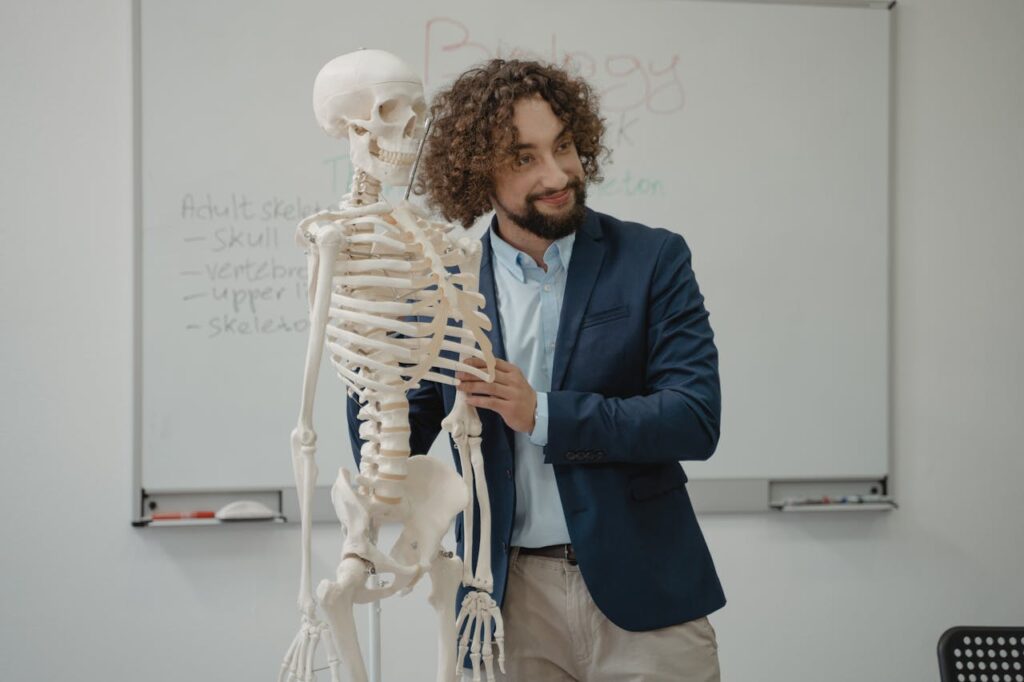
Every medical school structures things a bit differently, so in some universities, you also start getting a taste of the clinical side sooner than you’d expect. Most programmes include a “doctoring” or clinical-skills course where you learn how to take a patient’s history, do basic exams, communicate properly, and understand the professional side of being a doctor.
Some medical schools' 1st year have a heavy anatomy focus with hands-on practicals, manikin work, simulation-based learning and cadaver dissections.
However, what can make the pre-clinical years challenging isn’t that any single topic is impossible, but that there’s a lot of reading to be done. Expect to spend about 30 hours per week in independent study, in addition to 20-30 hours of lectures and labs.
Academic Preparation Tips for New Medical Students
Many students ignore proper academic preparation, making their 1st year rougher than it needs to be. The good news is that all you need is to plan your approach to organising study sessions throughout your years of study:

The Right Mindset for Med School Success
The most critical answer to “how to succeed in your first year of med school” is not overworking yourself, getting quality sleep, eating actual meals, and doing any form of physical exercise, to keep your brain from frying.
- Pick a daily study cutoff and stick to it. You’ll absorb more when you’re not forcing yourself to work 12-hour days.
- Be mindful. Talking to someone or doing 5 minutes of breathing/meditation stops stress from piling up.
- Take real breaks like walks, music, cooking, or anything not related to studying medicine. Your brain needs spaces where it’s not “on.”
Reviewing for Foundational & First-Year Med School Curriculum
Even if you’ve applied to medical schools with no entrance exams, review the basic scientific subjects like Biology and Chemistry. Dust off those old notes and refresh the basics to start off your studies as ready as you could be.
Don’t Look for Perfectionism
Instead, treat studying medicine like a marathon. Stay consistent without falling behind, focus on passing, and protect your energy. Burning out early is the number 1 mistake students regret later.
Medical School Study Strategies
Everyone learns differently. Some people need to see a visual representation so it sticks, others have to hear it, and many need a hands-on approach. If you’re not sure which studying approach works for you, try a learning-style quiz like VARK. It’ll show you if you’re visual, auditory, read/write, or kinesthetic. Once you know, you can set up your study habits to match how your brain actually works. Makes things a lot easier down the line.
You can also use high-volume study techniques like active recall and spaced repetition, especially when you’re preparing for your med school’s entrance exam or pre-reading for your 1st few classes.
Leverage Tools for Medical School Study
You will quickly realise that relying solely on lecture slides is not enough. Successful medical students use 3rd party tools to help them sketch, create flashcards, and organise their files from day 1.
A good example of these tools is Anki, which creates personalised flashcards covering a wide range of medical topics.
Building a Support Network

Being isolated in med school can set you back. It’s important to prepare socially and build a support network before the academic pressure hits. This network provides emotional support, academic clarity, and future career guidance. Both Medlink Students and many medical schools offer exactly this type of support
Older students (Y2, Y3, and Y4) are the most valuable in this case, as they can immediately tell you which resources can help with your school's exams. Establishing early relationships with your peers and seniors can also help you with finding out about research opportunities, while getting specific advice on speciality selection later in your journey.
Medlink Students helps you connect with older students and faculty at your school, while also giving you personalised advice from our own network of doctors and experienced academic advisors.
Finally, do not let the intense environment cut you off from the outside world. Keep in touch with family and friends for some emotional and work-life balance.
Time Management For Medical School
This gets its own section in the blog because building your time management skills is 1 of the most crucial soft skills you NEED during your medical studies. With the very high study volumes, cramming simply doesn't work. Time management is how you ensure consistency and prevent burnout. Some must-do planning techniques include:
Time-Blocking
Time blocking is the secret sauce here. Set specific, non-negotiable blocks for different activities:
- Focus Blocks (2-3 hours) for deep learning and mastery of complex concepts.
- Review Blocks (1-2 hours) to reinforce content using spaced repetition.
- Administrative Blocks (30-60 minutes) for emails, planning, and organising notes.
- Wellness Blocks for exercise, cooking, and sleep. These are non-negotiable.
Follow the Eisenhower Matrix
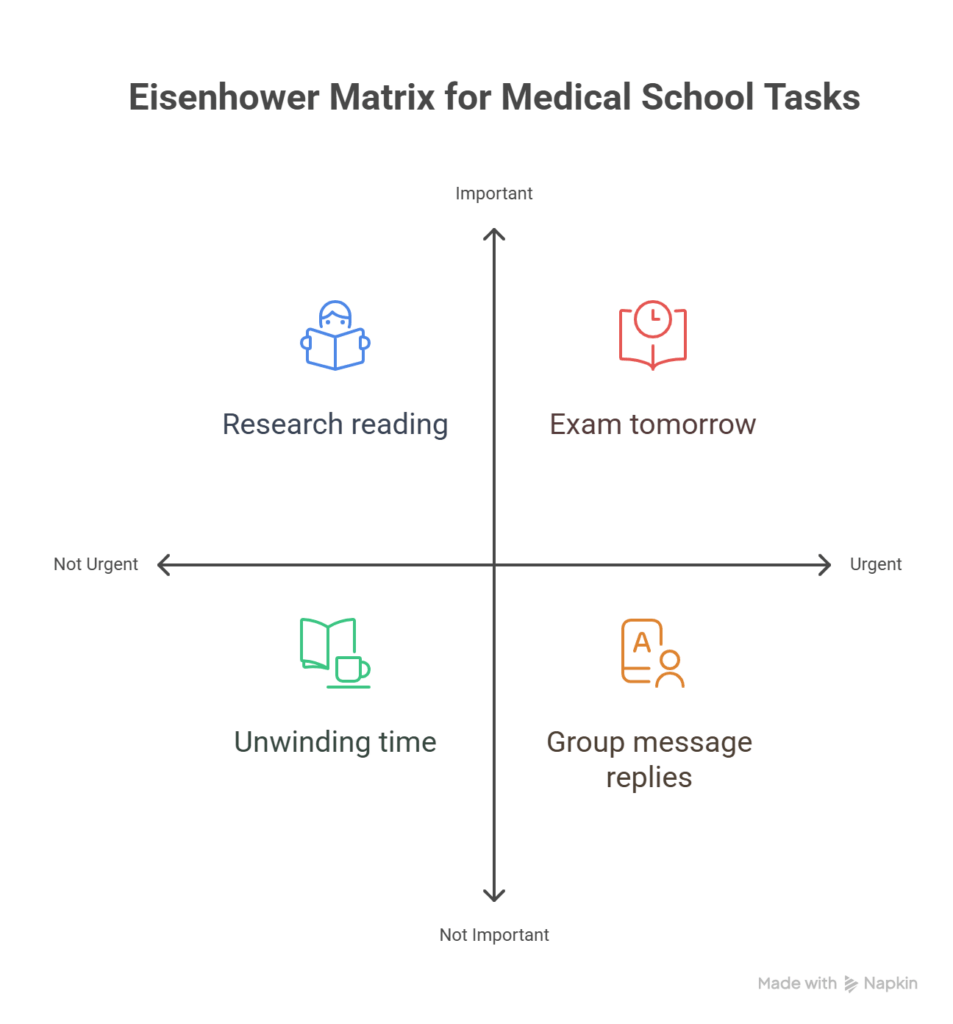
You can’t do everything at once, so this helps you sort your day out. Just split your tasks into 4 boxes:
- Urgent + important: do these 1st, like an exam that’s literally tomorrow
- Important but not urgent: schedule these for later, like doing some research or reading
- Urgent but not important: either pass it on or knock it out fast (like replying to group messages).
- Not urgent + not important: cut them out or keep them for your “okay I’m done” time for unwinding.
The Pomodoro Technique
Your brain needs structured breaks, especially for studying high-volume medical content. Try working on a single subject for 25 minutes, followed by a 5-minute quick break. After 4 sessions (120 minutes), take a longer 15-30 minute recharge break. This maintains your focus and decreases the chances of early onset of burnout.
Adopt the "Study Today's Material First" Rule
If you get behind, never try to catch up on yesterday's lecture before tackling today's content. Always prioritise the newest material to prevent the work from snowballing. Use small pockets of free time later to catch up on the backlog.
Sort Out Your Logistics Before Classes Begin
If you’re studying medicine, the last thing you want is other sources of stress, especially when it comes to finances and living. These are steps you must settle before classes start.
Financial Planning for Medical Students
Med school is a long-term investment, so ensure you join a medical school whose tuition is within your budget.
Additionally, you HAVE to make sure you have all your living expenses set straight based on your med school’s location. Look for accommodation prices, food, leisure, and transportation. It’s a good idea to also become familiar with budget management tools and applications; they can save you in the long run.
Have you not found a medical school that fits your needs yet? Book a free consultation with 1 of our expert advisors, and we’ll help you secure a spot at a top-ranked medical school in Europe, or check out our blog for 7 Affordable Medical Universities in Europe.
Choosing Safe and Affordable Accommodation
Where you stay affects everything - your headspace, how well you study, and how your whole uni life feels. Choosing the right accommodation basically sets the tone for an easier, smoother med school run.
Additionally, watch out for scams or sketchy landlords. According to a European Students’ Union survey, 25% of international students experienced housing scams, 49% were hit with large deposits, and 41% said they weren’t given clear information about the place they were renting.
Why We Care
Every system you don’t build now (financial, organisational, mental) can turn into a problem when classes start. The students who fall behind in the 1st year aren't usually the least intelligent, but the least organised. Your future as a doctor isn't just about how hard you work, it’s about how strategically you work.
You shouldn't have to figure out step prep timelines and advanced study techniques alone, let alone which medical school's total cost of living and tuition truly aligns with your long-term budget.
Book a free consultation with 1 of our expert academic advisors today, and we will go through your exact situation, so we can give you a solid, tailored plan to help you succeed, all while ensuring you've chosen the best destination for YOU.
FAQs
What to Expect in Medical School First Year?
Med school starts off with all the foundational sciences you need before getting into the clinicals. This also includes labs, manikin work, simulation-based learning and dissections in some med schools.
How to Succeed in Your First Year of Med School?
Start off before you even get there by sorting out your logistics early on. Then incorporate time management techniques like using flashcards, the Eisenhower Matrix, etc. Also, try building a support network of older students and mentors as a solid support column you can lean on.
What’s in the First-Year Med School Curriculum?
Foundational sciences like biochemistry, anatomy, physiology, histology and introductions to deeper medical topics. Review the basic sciences you've learned already before classes start, and your 1stmonth will be much smoother.
What Are the Best Medical School Study Strategies?
Never try to catch up on yesterday's lecture before finishing today's, and use studying techniques like active recall and spaced repetition. Also, figure out how your brain learns by taking a learning style quiz. Most importantly, though, use time-blocking. Cramming just doesn't work here.
Leave a Reply
About Medlink Students
Leading international recruitment company for medical students in Europe. British Council Certified Agents. 10+ years of experience and more than 10,000 students advised.