International Medical Internships 2026 Opportunities, Destinations, How to Apply

Medicine is becoming more competitive year by year, and students keep asking us for ways to stand out before, during, and even after their education.
It’s also 1 of the reasons why international medical internships have surged in popularity as a means to get experience and get a feel for your career to be, all while showing dedication to the field.
But not all internships are equal. Recognition rules depend on the country, hands-on work is often limited, and poor-quality programmes can raise ethical and/or safety concerns. If you plan on interning in 2026, it is mandatory to learn what international medical internships are really like, who they are suitable for, what options there are, how to apply, the costs, and recognition.
TL:DR
International medical internships are short-term, supervised clinical exposure abroad (hands-on training not guaranteed) with a lot of different options and locations. In 2026, they are expected to increase in demand, however, most are educational rather than accredited training, so always check with your university before applying.
Key Takeaways
- Expect structured supervision placements with limited hands-on work.
- International internships are available to pre-med students, medical students, and even graduates.
- Recognition varies, and most placements are educational rather than accredited training.
- Popular destinations include Europe, Africa, Asia, Latin America & the Caribbean, all for different reasons and opportunities.
- Strong placements fill early, so start planning at least 6 to 12 months ahead for 2026.
- Always verify supervision, safety standards, and ethics.
Table of Contents
- 1 What Are International Medical Internships?
- 2 Types of Medical Internships and What Roles Do Medical Interns Typically Perform?
- 3 How to Apply for International Medical Internships: A Step-by-Step Timeline for 2026
- 4 Which Universities Support International Medical Internships?
- 5 What Are The Requirements for an International Medical Internship?
- 6 What Documents Do You Need for International Medical Internships?
- 7 Where Can You Do an International Medical Internship in 2026?
- 8 How Do You Choose the Right Country for Your Internship?
- 9 How Much Do International Medical Internships Cost? Will I Be Paid?
- 10 How Can You Tell If a Medical Internship Programme Is Legitimate?
- 11 How to Make the Most of Your International Medical Internship
- 12 What Is the Difference Between a Medical Internship and Medical Volunteering?
- 13 What International Medical Internships Are There for Pre-Med Students?
- 14 What International Medical Internships Are There for Graduates or Post-Graduate Doctors?
- 15 What Medical Specialities Are Available For International Internships?
- 16 Are There Internship Opportunities in Dentistry, Pharmacy, or Allied Health?
- 17 Are International Medical Internships Recognised?
- 18 But Why Should Students Pursue International Medical Internships in 2026?
- 19 Why We Care and How Medlink Students Can Help
- 20 FAQ
- 20.1 Are international medical internships paid?
- 20.2 Can I go abroad for an internship during university holidays?
- 20.3 Are international medical internships the same as electives?
- 20.4 Can UK students intern abroad before Foundation training?
- 20.5 Are placements competitive?
- 20.6 Can an international internship count as clinical experience?
- 20.7 Do I need to speak the local language?
- 20.8 How long do international medical internships usually last?
What Are International Medical Internships?
International medical internships are short-term placements in hospitals, clinics, research centres, or community health projects outside the country you’re studying in. Typically, they last between 2 and 12 weeks and focus on:
- Observing clinicians at work
- Participating in teaching rounds
- Assisting with basic tasks under supervision, if permitted
- Learning about a different healthcare system
However, they are best thought of as educational experiences rather than replacements for licensed training, although there are medical universities that have established partnerships for recognised internships and externships.
Types of Medical Internships and What Roles Do Medical Interns Typically Perform?
The most common internships can be put into 4 main groups:
Clinical Shadowing Internships
Basically, learning directly from a doctor through observation. You will usually be introduced to doctor-patient interactions and participate in rounds to learn the whole hospital workflow. This is 1 of the most common types of internships, and it’s suitable for pre-med and/or current students doing their early clinical years.
Supervised Clinical Rotations
In some cases, mostly for senior medical students or those on formal electives, placements allow more structured clinical involvement under direct supervision. Even then, what you are allowed to do depends on local licensing rules and hospital policies.
Speciality Rotations
Some placements allow more focused exposure depending on institutional partnerships. Lately, the most popular specialities for medical internships have been: Emergency Medicine, Infectious Diseases & Tropical Medicine, Paediatrics, Women’s Health, Public Health and Global Health Outreach.
Some emerging and interesting areas you should keep an eye on in 2026 are Digital Health and AI in Medicine, which have been increasingly featured in research for personalised and predictive medical care.
If you’re a UK student currently studying abroad and looking into specialising, we have prepped the perfect blog just for you: Can I Specialise in the UK After Studying Medicine Abroad?
Public Health and Research Internships
These internships are all about how healthcare operates at a population level, rather than day-to-day hospital work. Popular ones include community health assessments, epidemiology projects, observing screening or vaccination campaigns, or participating in research.
Because the work is typically well supervised and non-invasive, these placements are often considered lower risk from a clinical standpoint. They are particularly relevant for students interested in public health, policy, global medicine, or academia.
How to Apply for International Medical Internships: A Step-by-Step Timeline for 2026
Applying for an international medical internship takes longer than most students expect, especially if your university needs to approve the placement or you have to go through strict visa rules. Starting out early gives you access to the best internships programmes and lets you avoid stressing about meeting deadlines.
TL:DR - start planning & short-listing 6-12 months ahead, start applying 4-6 months ahead and start prepping as soon as you get accepted.
We recommend planning your internship like this:
Preliminary Selection Stage (6 - 12 Months Before)
This is when you narrow down what you want and what you are realistically eligible for.
At this point, you should:
- Decide which specialities or what type of experience interests you most
- Shortlist countries or cities that fit your language skills and budget
- Check whether your medical school needs to approve overseas placements
- Compare programme structures, supervision levels, and hospital affiliations
- Look at past student experiences and outcomes
Bonus tip: If you are hoping to go during peak summer months, aim for the longer end of this window.
Application Stage (4 - 6 Months Before)
Once you have chosen your programme(s), it’s time to start the formal application process.
Most applicants are asked to complete application forms, submit a CV, provide transcripts, supply 1 or 2 academic or clinical references and write a short personal statement explaining their goals and ambitions.
Some universities also require internal paperwork at this stage to approve the placement as an elective.
Preparation Stage (2 - 4 Months Before)
After receiving an offer, it’s best practice to start looking into logistics right away, including.
- Applying for the correct visa and residence permit
- Arranging travel and medical insurance
- Securing medical indemnity cover if you will be in clinical settings
- Completing occupational health checks and vaccinations if necessary
- Organising accommodation and local transport
- Confirming start dates, dress codes, and supervision arrangements with the host site
Taking language tests or translation and notarising your documents may also be required for some destinations.
Which Universities Support International Medical Internships?
There are manyuniversities that actively help students arrange international clinical electives or internship-style placements through formal partnerships, exchange programmes, or global initiatives. Others are part of exchange networks, which can make it much simpler to apply.
Universities With Established International Pathways for Internships
These medical schools are known for having structured global programmes or for participating in exchange systems that can enable overseas electives.
Semmelweis University in Hungary

Semmelweis has extensive international partnerships and mobility agreements that allow students to join clinical rotations, electives, or research placements abroad in countries like Germany, Japan, Canada, the USA, and more.
University of Health Sciences Antigua (UHSA)
UHSA incorporates clinical training and international exposure into its medical programmes, with students being able to complete clinical rotations in affiliated teaching hospitals abroad, including in the UK. UHSA’s pathways provide supervised hospital experience while meeting licensing and accreditation requirements in partner locations.

Ross University School of Medicine in Barbados

Ross offers global health electives and international clinical experience opportunities in many locations as part of its medical curriculum.
European Universities With Established Exchange Networks
Many European medical schools participate in Erasmus or bilateral mobility agreements that can support short-term clinical electives at partner locations across Europe and beyond.
These include:
- European University Tbilisi
- The Tbilisi Medical Academy
- Medical University of Bialystok
- Medical University of Lodz
- Poznan University of Medical Sciences
- Charles University (First, Second, and Third Faculties of Medicine)
- Riga Stradins University
- University of Pecs
- Jessenius Faculty of Medicine at Comenius University

How Students Can Get Internships Even Without University Support
Not every medical school runs a dedicated international internship programme, but in practice, students can apply on their own through:
- Exchange systems such as Erasmus+
- Teaching hospitals, if they have global health elective agreements
- External internship facilitators that place students in accredited teaching centres (remember to get your med school’s approval first)
Students can also organise international clinical exchanges through organisations like the International Federation of Medical Students' Associations (IFMSA), the World Health Organisation (WHO), the United Nations Children's Fund (UNICEF), the Pan American Health Organisation (PAHO), and many more.
The links will lead you directly to their internship webpages.
What Are The Requirements for an International Medical Internship?
International medical internships are open to both students and professionals who are just starting out their careers in healthcare. Many programmes accept applicants interested in medicine, dentistry, veterinary medicine, pharmacy, physiotherapy, public health, or related health sciences.
Although each country and each programme have a different set of rules, the general requirements ask that you:
- Are at least 18 years old by the programme start date
- Have completed secondary school
- Demonstrate proficiency in English, with some destinations asking for local language skills
- Provide a clean criminal background check
- Meet vaccination and occupational health requirements
- Supply academic transcripts or proof of enrolment where relevant
Quick note: Although many European placements are done in English, some still require at least conversational knowledge of the local language.
Does Your Level of Study Matter for Internships?
Yes. Pre med students usually join observational placements or community health projects, while medical and healthcare students may be eligible for structured clinical electives or speciality placements, subject to local rules.
Finally, graduates or postgraduate doctors are usually restricted to observerships or research roles unless they obtain local medical registration or licensing that permits direct clinical practice.
When applying, reputable providers should review your academic stage and recommend placements that match both your experience and what local regulations allow. If a programme promises full clinical duties regardless of background, that is a red flag.
What Documents Do You Need for International Medical Internships?
Most programmes and host hospitals ask for:
- A valid passport
- Appropriate visa or study permit
- CV outlining education and clinical experience
- Proof of enrolment or graduation and academic transcripts
- Letter(s) of good standing or recommendation
- Immunisation records
- Professional indemnity and health insurance
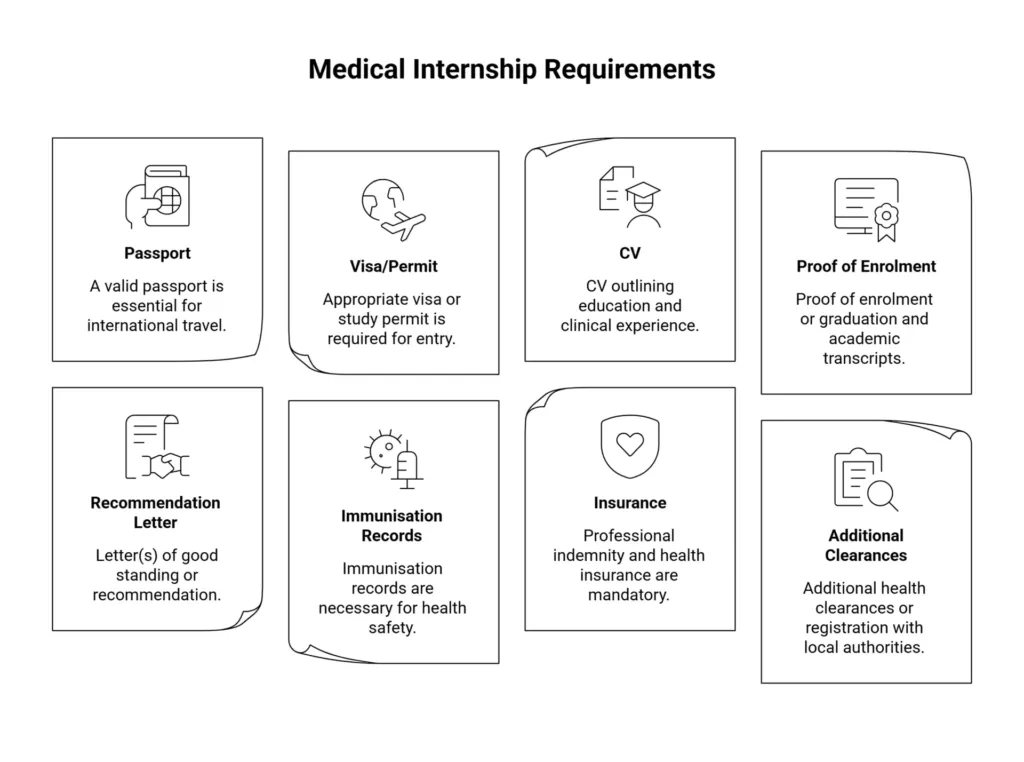
Many countries now also ask for additional health clearances or registration with local health authorities, including police or background checks, occupational health screening and in some non-EU countries, registration with national bodies may be required even for observational roles.
Always check the country requirements well in advance, as they can differ by a lot.
Where Can You Do an International Medical Internship in 2026?
International medical internships are generally available in many parts of the world, but the experience you get can vary by a lot. Rather than focusing on what sounds appealing, it is better to think about what each region offers from a learning and practical standpoint.
For instance:
International Medical Internship in Europe
In Europe, you can expect international internships to be more structured and focus on research, shadowing, or formal electives arranged through universities or teaching hospitals.
Europe is a good destination if you’re looking for:
- Academic or laboratory-based placements
- Short-term observerships
- Exposure to different training models
- Convenient travel logistics
But keep in mind that hands-on clinical work is often limited unless the placement is part of a formal university exchange.
International Medical Internship in Africa
Placements in Africa are generally about community health work, public health initiatives, helping in rural clinics and getting hospital experience in larger cities.
Placements in Africa are best for students who want to:
- Learn about primary care in lower-resource settings
- Understand global health delivery
- Observe tropical medicine and preventative programmes
- Work with multidisciplinary teams
Ethical oversight and proper supervision are especially important here, so choose programmes with long-standing local partnerships.
International Medical Internship in North America
In the United States and Canada, international placements are also very structured and visiting students join formal clinical electives, observerships, or research roles rather than informal internships.
North America is best for students who:
- Want university-approved clinical electives
- Are interested in research or laboratory placements
- Want exposure to advanced healthcare systems
However, application timelines here are long, the competition is high and the costs can be significantly higher than in other regions.
International Medical Internship in Asia
Asian internships are known for their large teaching hospitals with high influx of patients, busy clinical environments, and exposure to a broad spectrum of conditions. Some centres are closely linked to medical schools and run formal elective programmes, while others focus more on observational placements.
If you’re looking at Asian medical internships, you can expect to:
- See high patient volumes
- Experience different diagnostic and treatment approaches
- Learn about infectious disease or community medicine
- Join structured hospital electives
However, language barriers can be tricky here, so check whether teaching is offered in English.
International Medical Internship in The Caribbean & Latin America
Latin American placements are often based in urban hospitals, with some opportunities in community clinics. Here students can:
- Learn about tropical diseases
- Experience a wide range of public and private healthcare systems
- Take part in elective-style hospital rotations
A footnote on availability: placements change frequently depending on hospital capacity, visa rules, and academic calendars, so check which hospitals are actively hosting visiting students.
How Do You Choose the Right Country for Your Internship?
A good destination is not the one that sounds most impressive, but one that matches what you want to get out of the experience and if it matches your level of training.
Before you decide, ask yourself these 7 questions:
- Can you communicate safely and freely?
- Are you looking for hospital-based learning, research, or a mix?
- Who will be supervising you day to day, and to what extent?
- How safe is the area, and what support is available if something goes wrong?
- Will your medical school approve?
- What is the real total cost once you include accommodation, transport, insurance, and visas?
- Will this particular placement be beneficial to your future career?
If 2 countries look equally appealing, choose the one with clear supervision, named professionals you will be working with, and stronger safety standards.
If you’re looking for more tips on arranging your clinical rotations while studying abroad, you can check out our blog about: Can You Work in Hospitals or Arrange Clinical Rotations While Studying Abroad?
How Much Do International Medical Internships Cost? Will I Be Paid?
You may be asking, if it’s an internship, maybe I’ll be getting paid? Well, the short answer is no, most international medical internships worldwide are not paid. In fact, many require students to pay fees rather than receive a salary.
You may have also guessed that the overall costs of your medical internship can change a lot depending on the country, the length of your stay, and the actual terms of the programme. When budgeting, you should take into account:
- Programme fees
- Accommodation
- Airport transfers or local transport
- Meals
- Flights
- Travel and medical insurance
- Visa applications
- Vaccinations and health checks
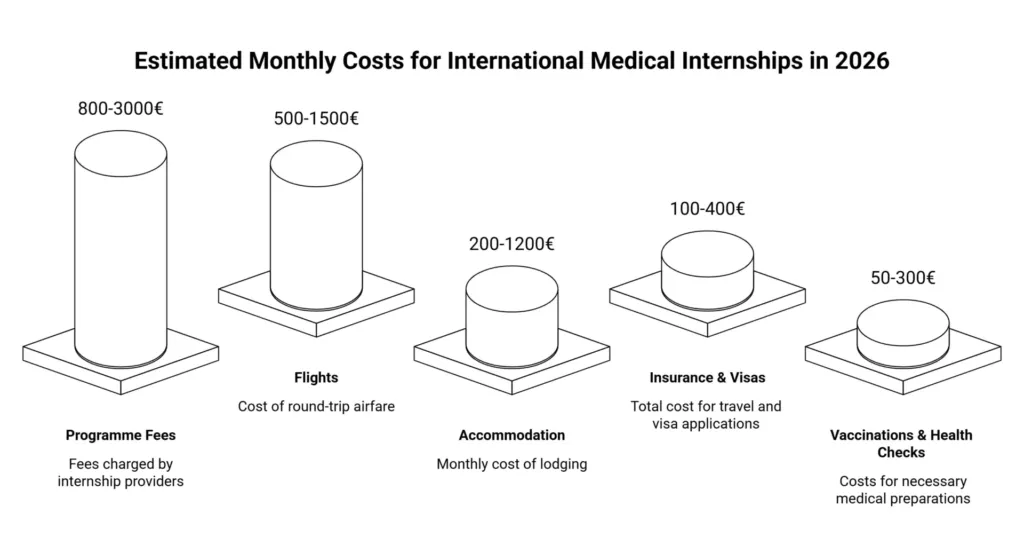
In 2026, you can expect international medical internships to be in the ballpark of:
- €800 - €3,000+ per month for programme fees
- €500 - €1,500+ for flights
- €200 - €1,200 per month for accommodation
- €100 - €400 total for insurance & visas
- €50 - €300+ for vaccinations/health checks:
Some university exchanges or research placements only require you to cover living costs, while programmes run by private organisations usually charge hefty fees. Always check exactly what fees you are expected to cover before embarking.
How Can You Tell If a Medical Internship Programme Is Legitimate?
If an internship programme is legitimate, you should be able to easily find:
- Who will supervise you day to day, including named clinicians
- What you are expected to learn and observe
- Which hospitals or universities they work with
- How fees are structured and what they cover
- Safety procedures and on-call support
- Emergency contacts and local coordinators
- The limits of your role and level of patient contact
Unfortunately, there are concerns for both ethics and medical standards in some destinations for medical internships. Quality depends on the providers, so you should do proper research before deciding, which is why we advise planning 6-12 months ahead of time.
A small caveat: Be sceptical of vague descriptions and grand promises. Any programme advertising unsupervised or unrestricted clinical practice for visiting students should be avoided.
How to Make the Most of Your International Medical Internship
An international placement can genuinely shape your future career, but the value you gain depends on how you approach your experience. Treat the internship as a chance to learn rather than something to collect for your CV.
Set Goals
Before you arrive (or better yet, before you even choose your internship), decide what you want to get out of this experience. Typically, you will want to learn how hospital teams function, what a doctor’s day-to-day responsibilities are, learning how care is delivered in different regions, and the intricacies of your chosen speciality.
Stay engaged and observe actively
Even when your role is mainly observational, pay close attention to how clinicians work and how patients go through the system. Keep brief notes, ask questions when appropriate, and remember to stay within the limits of what you are permitted to do.
Build professional relationships
Introduce yourself clearly, be available and reliable, and thank staff who take the time to teach you. Where appropriate, you can ask for feedback or a reference at the end of the placement. These relationships often become 1 of the most valuable parts of the experience.
Lean local culture
Approach unfamiliar practices with curiosity rather than judgement. Learn basic local phrases, follow hospital etiquette, and ask for guidance when unsure.
Use the experience you’ve gained
Once you return, think about what surprised or challenged you, which specialities now interest you more or less, and how the experience fits into your long-term plans.
What Is the Difference Between a Medical Internship and Medical Volunteering?
The two are often grouped together, but they serve different purposes and carry very different levels of responsibility.
International medical internships are designed as educational placements within hospitals or clinics with clear learning objectives and named clinical supervisors. They should have structured schedules in teaching hospitals for roles matched to your stage of study.
Medical volunteering programmes are generally “broader” and may focus on community health or social projects rather than hospital-based training. Typically, there’s less formal teaching arrangements with limited or no clinical exposure. Unfortunately, you can also expect a wide variation in supervision standards
Generally, internships are definitely the way to go, as they have defined standards, learning outcomes, and are usually safer and more defensible on applications. They show that you sought proper oversight, respected local regulations, and understood the limits of your role.
However, that shouldn’t stop you from volunteering if you have the opportunity.
What International Medical Internships Are There for Pre-Med Students?
Yes, although they are usually observational rather than hands-on.
Direct patient care is normally restricted by law and hospital policy and any programme that advertises unrestricted clinical practice for pre-med students should raise immediate concerns about safety and ethics.
What International Medical Internships Are There for Graduates or Post-Graduate Doctors?
Some international programmes do accept graduates and early career doctors, but the rules are usually much tighter than for students.
Direct patient care nearly always requires temporary registration or a medical licence from your chosen country, which can definitely be hard for short-term visitors to obtain. Because of this, graduates should be cautious of placements that promise independent clinical work without clear regulatory approval.
If you have already completed medical school, it is extra important to confirm exactly what your responsibilities would be, whether supervision is guaranteed, and if the experience would be recognised by employers or training programmes at home.
What Medical Specialities Are Available For International Internships?
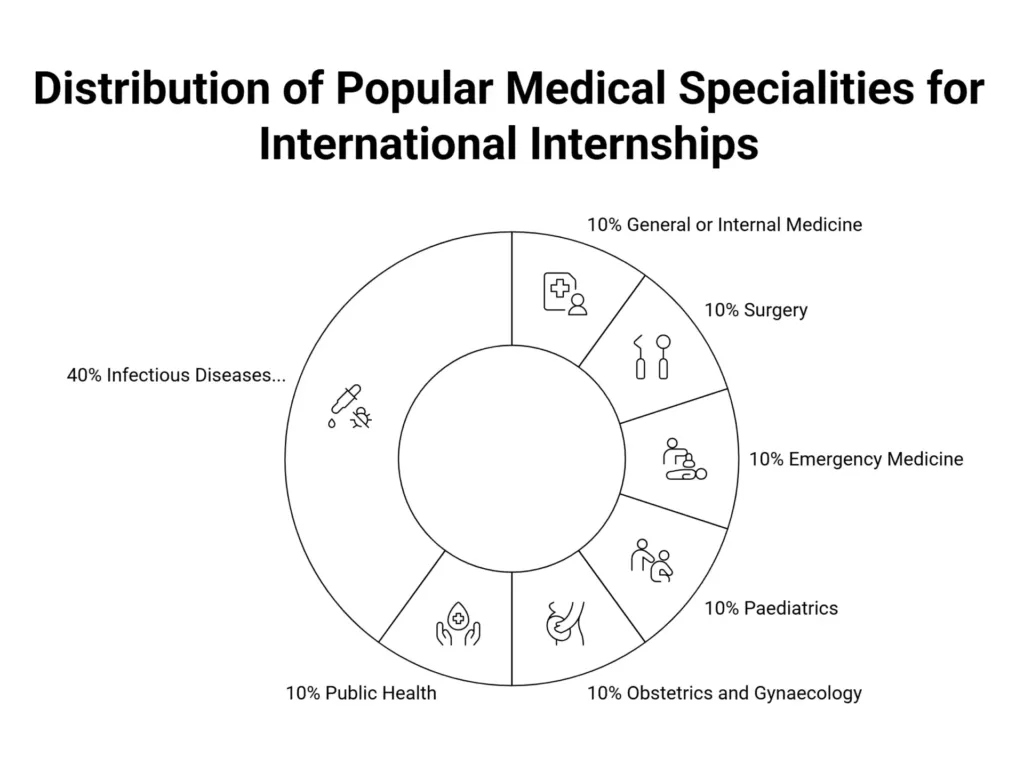
Most popular ones include:
- General or internal medicine
- Surgery
- Emergency medicine
- Paediatrics
- Obstetrics and Gynaecology
- Public health
- Infectious diseases
- Anaesthetics and critical care
- Psychiatry
- Family medicine
- Primary care
- Radiology or imaging
- Orthopaedics
Some teaching centres also provide more specialised experiences, like tropical medicine units, rural outreach programmes, or community-based primary care. However, availability often changes from year to year, so always confirm what is realistically offered for 2026 before applying.
Are There Internship Opportunities in Dentistry, Pharmacy, or Allied Health?
Yes. Many international programmes run placements for students in several disciplines, which can include Dentistry, Pharmacy, Veterinary Medicine, Nursing, Physiotherapy, Public Health and more.
And sure enough, each field comes with its own rules and limits on patient contact, which also depend on the country. Just like with medical internships, always check what you’re actually permitted to do at your level of training and whether the placement is recognised by your university.
If you’re currently studying dentistry, then our blog can definitely help you choose your specialisation: What Are the Different Types of Dentists & Dental Specialities?
Are International Medical Internships Recognised?
Sometimes, but not always.
Most international placements are treated as enrichment experiences rather than formal clinical training. They can definitely strengthen your application by showing dedication and motivation, but they rarely replace required rotations or internships within your home medical system unless they are pre-approved as electives.
Before committing to an internship, always check:
- Whether your medical school will formally approve the placement
- If it can count towards elective or curriculum requirements
- What certificate or documentation you will receive
- Whether professional or licensing bodies impose limits on overseas experience
Always get a written confirmation from your university or relevant authority that your internship will be recognised.
But Why Should Students Pursue International Medical Internships in 2026?
Medical training is extremely competitive across Europe and the US, so many students are looking for ways to build a stronger resume while getting more clinical experience. International medical internships are a great way to step outside the healthcare system you’re already familiar with and see how well you fare in different clinical settings.
They’re also a great way to find the speciality that suits you best.
Do International Medical Internships Help With Applications?
They definitely can, but only if you show what you’ve gained from the experience, rather than simply listing where you went.
Admissions panels and interviewers are usually more interested in what you learned about clinical practice and how you worked within a team. You can also expect to be asked about your understanding of professional ethics and boundaries, as well as how you handled unfamiliar or challenging situations.
Prestige alone carries little weight (albeit still some). However, a well-chosen placement in the field you want to specialise in with strong learning outcomes is far more persuasive than a famous hospital name with no clear gains from the experience.
Why We Care and How Medlink Students Can Help
Choosing a low-quality international medical internship can not only waste your time but also thousands of euros. Unfortunately, students have come to us after they've chosen a speciality on their own, but only realised too late that their placement was not recognised by their university and that it delivered far less clinical exposure than advertised.
That is why at Medlink Students, we take international medical education and internships seriously. We only work with accredited, high-quality and internationally recognised medical schools that can only be a benefit to you, rather than a detriment.
Our knowledge, experience, and expertise let us guide students on which universities have established international medical internships that can help you become a better doctor. Once you’re in, we can help you with which internships suit your level of study, what programmes have genuine hospital partnerships and how to avoid high-risk providers. If you are planning an international medical internship in 2026, the right guidance can be the difference between a career-building opportunity and a costly mistake.
FAQ
Are international medical internships paid?
Most are unpaid, and students usually cover programme fees, accommodation, and daily living costs. Some university exchange or research placements may be lower cost or even offer small stipends, but paid clinical internships are uncommon and should always be verified in writing.
Can I go abroad for an internship during university holidays?
Yes. Many internships are designed for summer or winter breaks, and shorter ones of 2 to 8 weeks are especially popular with students.
Are international medical internships the same as electives?
Sometimes. An international internship may count as an elective if your medical school formally approves it, but many do not. Always confirm with your university before applying.
Can UK students intern abroad before Foundation training?
Observational internships or approved electives are usually possible. However, independent clinical practice abroad is heavily regulated and normally requires local licensing, which short-term visitors rarely receive.
Are placements competitive?
Yes. Well-supervised hospital programmes and popular destinations can fill months in advance, particularly for summer dates, so apply as early as possible.
Can an international internship count as clinical experience?
It can provide valuable exposure and learning, but whether it counts formally depends on the medical authority body in your home country, as well as the host hospital’s programme. Most are considered educational rather than accredited training.
Do I need to speak the local language?
It depends on the country and hospital. Some placements operate in English, while others require at least conversational local language skills for safe communication with patients and staff.
How long do international medical internships usually last?
Most run between 2 and 12 weeks, though research placements or formal electives may be longer.
Leave a Reply
About Medlink Students
Leading international recruitment company for medical students in Europe. British Council Certified Agents. 10+ years of experience and more than 10,000 students advised.