What Are The Easiest Countries to Study Medicine In?

Applying to medical school is intimidating to many. It’s a long process, you’re going through entrance exams, interviews, endless applications and papers with no guarantee of getting in whatsoever.
With acceptance rates often in the single digits in some countries, competition has never been fiercer, and many talented students are rejected year after year despite strong grades and test scores.
So who wouldn’t want to look for an “easy” country to study in? But by easy, we don't mean lower academic standards or an inferior quality of education, rather accessible and flexible entry requirements.
In this blog, we’ll discuss the easiest countries to study medicine in, so you can maximise your chances of getting into medical school and become the doctor of your dreams.
The key takeaways of this blog include:
- “Easy” here really means accessible, as in clear entry rules, alternative routes like foundation years, and fewer one-shot exam barriers.
- European countries like Georgia, Poland, Latvia, Cyprus and Serbia offer English taught and accessible medical degrees
- These degrees are internationally recognised (GMC, USMLE pathways, EU mobility)
Table of Contents
- 1 What Do We Mean by “Accessible” Medicine Entry?
- 2 How Do You Choose the Right Medical School to Study Medicine Abroad?
- 3 Which Countries Are More Accessible for Medicine Abroad?
- 4 Serbia
- 5 Why We Care
- 6 Q&A
- 6.1 What are the easiest countries to study medicine in?
- 6.2 How do I study medicine abroad without UCAT?
- 6.3 What are the best medical schools in Europe for English speakers?
- 6.4 What are the medicine entrance exams for Europe like?
- 6.5 How is studying abroad different from the UK?
- 6.6 Are Medical Degrees in Europe Recognised?
What Do We Mean by “Accessible” Medicine Entry?
Easy doesn’t mean low standards. It means systems that:
- Have clear, predictable, and flexible admissions criteria/requirements
- Offer alternative entry routes (foundation years/pre-med, graduate entry, multiple intakes)
- Don’t hinge on 1 ultra-competitive exam
- Provide supportive learning environments
- Teach in English with international recognition and good graduate outcomes
How Do You Choose the Right Medical School to Study Medicine Abroad?
Low grades don’t automatically kill your shot at medicine in Europe or the Caribbean. The bigger problem is picking the right school out of 100s of options. Start with these 6 questions and you’ll filter the noise fast:
- Is the programme English-taught?
- Are entry requirements transparent?
- Do they offer alternative routes (foundation year, graduate entry)?
- Is the degree accredited and internationally recognised?
- Do they support international student transitions and clinical placements?
- Can I specialise after I finish my MD?
If you’re not quite sure yourself or have even more questions, you can sign up for a free consultation with 1 of our academic advisors. We’ve guided thousands of students just like you towards studying medicine, dentistry, pharmacy, vet medicine and more.
Which Countries Are More Accessible for Medicine Abroad?
Countries in Europe and the Caribbean offer excellent yet very accessible medical degrees. Top medical schools abroad, according to stats, price & quality, include:
Georgia

Georgia is the literal definition of accessible. Some medical schools in the country don’t require entrance exams. Instead, they’ll focus on your high school record, motivation, and interview, which makes admission more predictable.
Degrees from established universities in Georgia, such as the European University and Petre Shotadze Tbilisi Medical Academy, are internationally recognised, including by the GMC in the UK. Graduates regularly go on to practice in Europe, the UK, and the US (with the right licensing exams).
Most universities here have several intakes throughout the year in February and March or September and October. So if you miss the September deadline, you can start in March. Tuition is affordable, class sizes are small, and the student support systems are exceptional from day 1.
Poland

Poland has long been 1 of the main destinations in Eastern Europe for students seeking reputable, EU-recognised medical degrees in English.
You’ll need a high school diploma and strong grades in at least two science subjects to apply to Medicine, plus a short interview-style entrance exam that checks your motivation, basic science knowledge (like Biology and Chemistry), and English, rather than a heavy written test.
For premed, you also need a high school diploma (A-levels/IB/EB accepted) and advanced knowledge in at least two relevant subjects, as in Chemistry, Biology, Physics, Mathematics and English.
Plus, Polish med schools are known for early clinical exposure and strong preparation for licensing exams like PLAB and USMLE.
Cyprus

Each year, Cyprus attracts more than 10,000 international students, partly due to the English taught medical programmes, such as those at the University of Nicosia and European University Cyprus.
Entry requirements are relatively easy, but competition is heavy. You will need to have very high grades in high school (about 90% or the equivalent) and excel in your application, which includes an interview.
The University of Nicosia has a graduate entry pathway that allows students with a premed degree to directly apply for the 4-year MD. Medical degrees offered are internationally recognised, and studying medicine in a Mediterranean setting is a significantly enjoyable experience for many students.
Latvia
Some universities in Latvia offer English-taught medicine without a formal entrance exam, instead focusing on your grades, interview or documentation.
Medical programmes are recognised internationally, and you’ll get clinical exposure early. Not to forget, structured courses, clear deadlines, and focused support for international applicants, especially at Riga Stradins University (RSU).
Antigua & Barbuda
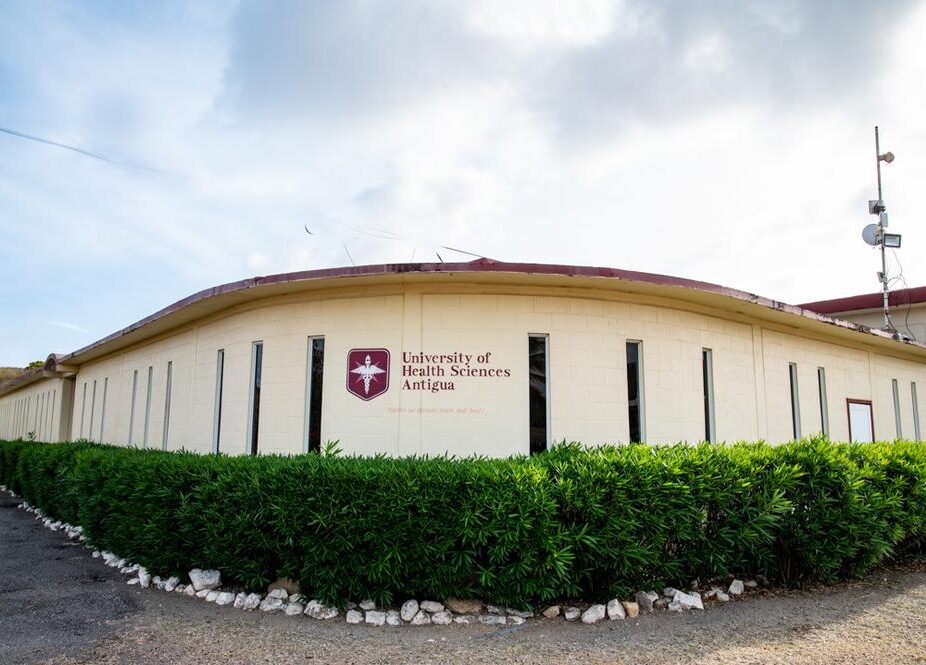
Antigua & Barbuda is home to the UHSA, a highly respected, internationally recognised and American-style medical university with absolutely no medical entrance exam required. Its admission criteria for its 4 year medical degree are straightforward;
- A Bachelor’s Degree or at least 3 years of study (worth a minimum of 90 credits)
- Students need to have gone through the required coursework* with official transcripts
- Personal statement
- 2 letters of recommendation
In case you don’t have a bachelor’s premed degree, you can get accepted into a pre-med programme at UHSA with a high school diploma, a minimum grade of C in English, Mathematics, and Chemistry and a minimum overall GPA of 2.0 or equivalent.
Serbia

The University of Novi Sad in Serbia is your go to for a medical programme in English that integrates theoretical knowledge with practical experience.
You will need an entrance exam in Biology and Chemistry, English proficiency certificate and a high school diploma. Pretty straightforward.
Note that when applying through Medlink Students, you’ll have the exclusive option to sit the entrance exam online remotely.
Cost of living is low (Around €700 a month including rent), degrees are internationally recognised, and graduates go on to practice across Europe, as well as the UK.
Why We Care
Every year, between 20 to 30 thousand students in the UK apply to take the 9500 annual seats in medical schools, and obviously, thousands are rejected, not because they aren’t good enough, but because of overcrowded applicant pools, 1-shot exams, and non-transparent admission rules.
Many never realise that better, more accessible routes exist.
And whether it’s Georgia, Poland, Serbia, or Cyprus, we’ll take care of matching you with the right school, handling your paperwork, preparing you for interviews, and supporting you in all you need to become a doctor. If you’re serious about studying medicine, apply for a free consultation today, and we’ll take care of the road for you.
Q&A
What are the easiest countries to study medicine in?
How do I study medicine abroad without UCAT?
You do that by applying to universities that don’t use UCAT at all. Examples being some medical schools in Georgia, Poland, Latvia, and Cyprus.
What are the best medical schools in Europe for English speakers?
There are many medical schools that fit into that criteria, such as European University, University of Novi Sad and University of Bialystok; Obviously, choosing one can be overwhelming, so book a free consultation with one of our expert advisors today, and we'll help you figure out which option suits your needs best and guarantee your path to becoming a doctor.
What are the medicine entrance exams for Europe like?
When there is 1, it’s usually basic Biology and Chemistry, but some universities don’t offer any entrance exam.
How is studying abroad different from the UK?
While both studying in the UK and abroad provide high-quality medical education, UK medical schools are extremely competitive and expensive, while studying abroad offers a more realistic and affordable path.
Are Medical Degrees in Europe Recognised?
Yes, since they’re listed in international directories (WDOMS), recognised for UK GMC registration, accepted for USMLE/ECFMG paths valid in Canada, Australia, and across the EU, meaning your degree still holds up for licensing exams and real clinical work anywhere you want.
Leave a Reply
About Medlink Students
Leading international recruitment company for medical students in Europe. British Council Certified Agents. 10+ years of experience and more than 10,000 students advised.